My Season of Doubt.
The noise of life is getting to me. There is no comfort anymore. I feel constricted and irritated by all the stupidity swirling about me. The seriousness of life has been replaced by petulant mood swings from without and within. Being a cancer survivor with a lifestyle as a professional patient has nothing to offer me because it is not my life. I got metastatic cancer which has put my body into the hands of a medical world that has no holistic standpoint. Medical departments do not communicate with each other and promises and proper appointments get overlooked. An oncology appointment is made without a PET Scan getting organized. A hearing test is promised and forgotten. Times made to remove stitches are overlooked. My request for a navigation nurse is a puzzle to receptionists who take no responsibility for the need to a create a correct timeline: PET Scan first, then Oncology specialist appointment. Maybe they believe it is my job to arrange the scan and other appointments which I do, but I am not convinced it should be my responsibility. It seems I am not chronic enough but still needing six-month PET Scans. The system says I am a Professional Patient after all. It is dispiriting. At the last ENT (Ear, Nose and Throat) six-monthly appointment, the specialist began with stating that patients with my condition have limited options and usually die, I have one foot in the grave. It is like spending big money to own a computer to realise it never belongs to you as it depends on an operating system owned by Google or Microsoft. Huge offshore conglomerates who never have your interests in mind—accept or disconnect. My body is owned by a medical system that has defined illness as an identity for me. A chronic health condition is integrated into me.
Illness identity not only expresses how I view the disease and the required treatment, but also how much the disease affects the way I think about myself and the degree to which the illness becomes integrated into my sense of self. Cancer dominates my identity and daily life. I see it in the mirror, from the looks of others. I feel it when my neck moves into the wrong place, pain is constant. Radiology has given me loud ringing tinnitus, there are no quiet moments for me while I am conscious. Immunology gave me side-effects that still linger. So, I am engulfed, overwhelmed, and dominated by disease. Given my unexpected and almost immediate diagnosis, this is an entirely understandable response. This is an absurd world where every day through our media we are told what to do, what we should do, what to think and believe, especially around health. A persuasive negative indictment of how one lives. I had a nagging, dispiriting mother who sucked the life out of me, cancer is like that and just as traumatic and triggering as all the health naggers out there. After three-years in the hospital system I have a difficult relationship with nurses and doctors, especially bossy ones or emotionally careless ones and the system is full of them.
At first, I lived in a dream-state rejection where the cancer was rejected as part of my identity as I saw it as unacceptable to the image of myself. At diagnosis, I was not at the point where I could reject what I could not understand, accept, or control. But sometime after surgery, I felt powerless and bitterness has grown. It pisses me off. Acceptance is the degree to which a patient accepts their illness as part of their identity and integrates it with their other social roles. Acceptance is finding a balance between illness and living life. I tried to find support, what a joke! Friendships are not forged in the waiting room—even the caregivers rarely converse and some can be very terse. There is no place for me in so-called cancer support groups as people do not want to talk about their disease with any ease. Online is horrible with empty platitudes and unwanted herbal cures. We are resigned, even accepting, and wait to move forward, to no longer be defined by our cancers.
But when the cancer is obvious to an observer it does define us, as does the constant need to attend to hospital department appointments. I see dermatology, plastic surgery, ENT, audio services, X-ray, and oncology departments along with my GP who attends to blood tests, punch biopsies, and prescription medications. When patients are diagnosed with cancer, they begin to negotiate their illness identity in relation to their past and future selves, their relationships, and their group memberships. Therefore, how patients view their cancer in relation to their other identities may affect how and why they make particular decisions about treatment options. Practical implications include disappointments in broken or tense visits with specialists.
As a cancer patient rather than as a cancer survivor I have become depressed as I feel trapped by a system that only has band-aid solutions rather than any resolutions. The metastatic cancer could recur, more skin cancer is recurring, uncertain side effects are inevitable, and further intervention is certain. An never ending cycle of treatment that is time consuming and tests my tolerance of types of people I would rather not know. The concept of cancer identity has grown in me as I am living with cancer as a chronic illness. There is little enrichment for me in my coping with this disease as I have survived so much and I feel I have come to the end of my time.
I have developed a broken heart, my response to cancer. One becomes obsessive with fairness by figuring out what to do with a traumatic new normal. My mind tricks me into initiating this wild ride of hopelessness, nothing seems to be on my side. Heartbreak is far more insidious than we realize because it is repetitive and addictive, we have been made into addicts withdrawing from illicit drugs. I have been going through withdrawal. And since I could not have the heroin of actually being without the hurt my unconscious mind chose the rehab of delusions of the past. My feelings told me I was trying to solve a mystery, but what I was actually doing was getting my fix. Heartbreak is so difficult to heal. Addicts know they are addicted. They must shoot up. But heartbroken people do not and if your heart is broken, you cannot ignore that. One has to recognize that with every act of rumination you are just feeding your addiction, ensuring a future of suffering. For people with Asperger’s, rumination is a sad part of our makeup, we are compulsive thinkers and collectors of people, things, and memories. I cannot just turn off, I am filled to overflow with thoughts. It is harder for me to forget, to forgive, to forge into something more adaptable. But I have learnt to acknowledge uncertainty, I have known how I am going to feel day-to-day is hard. I wish I could predict how things will go. There are aspects of my life that are beyond my control, I go into situations hoping for the best.
But, some things are in my control. I make to-do lists, in general, I create a routine that feels helpful to me, I garden, I paint pictures, I do my share of household chores, and my extreme-sport is walking. I can walk for long distances, walking past tiredness. This also reminds me I am a resilient person, I get through rough times, I cope somehow. Most of my life has been hard. While it is true that positive outcomes cannot be guaranteed, it is also true that negative outcomes are not guaranteed. We often automatically think that uncertainty will lead to a bad outcome because it feels dangerous, and we want to protect ourselves from a bad outcome. Yet, uncertain simply means unknown, it is a matter of chance. When I was younger, I walked into places blindly and did quite well. I never had a plan. But sometimes I was so depressed, I lost time and woke up to changed circumstances, surprised even shocked at the changes in my life, a combination of social isolation and my lack of executive functioning. Pulling back to the present moment became a surprise to me. Uncertainty is about the future. More specifically, it is focused on the fear of the unknown in the future, but for a long-time in my younger years the world seemed to change so slowly. Then life sped up for periods and I lost touch with what was in my present time. The world was moving on with the sense of past and future still there.
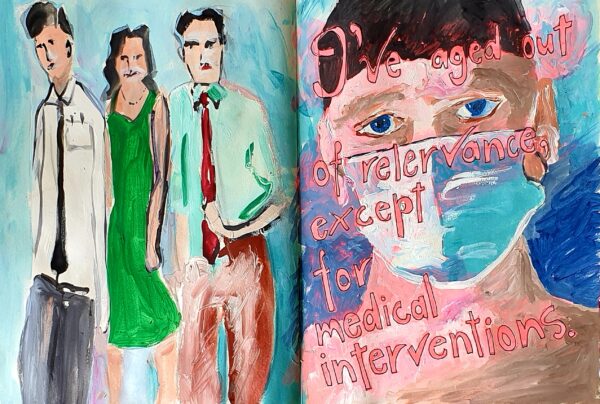
Establishing a new normal based on my circumstances today is what I have been doing. I acknowledge and honour the losses I have experienced and consider what would be a helpful new normal now based on the current circumstances. I do this through my Artist Diary entries which has become a routine that take some time to brainstorm. What have I done today to feel proud? I am in a fight for my life. The struggle I endure to live well. I admit to long periods of sadness made worse by pain around my surgery sites. The tinnitus in my brain is a noisy reminder too I am an unwell person. My health is constantly monitored. I struggle to maintain my weight and blood sugar levels. High sugar levels can prevent a PET Scan. My blood pressure is always too high, it interferes with my wellbeing and some medical procedures. Old age for me is not jolly. It presents challenges so difficult I understand why so many older people just give up and become moribund. The image of myself is unattractive and the world is so hostile now, I feel attacked from within and without.
However, I have discipline over emotion, I am not my out-of-control parents. My mother was insane with schizophrenia and my father undoubtedly passed on Asperger’s to me, both were impossible to talk to, no sense ever got in. At least I am not like them; they were always a step away from cruel violence. I will continue to walk and battle my sadness. I have chosen higher education over dull ignorance and move with more empathy than my parents showed me. I have been so disappointed in my life giving up is not an option. I recently viewed Disclosure Day (2026), directed and produced by Steven Spielberg who makes wonderful films. Positive and hopeful, the Earth’s future portrayed will be a grand adventure. So, in parallel I hope to have a grand adventure and put everything into context for that to happen even if every day can be uncomfortable. We cannot just surrender our wills on purpose. When it becomes perfectly clear to us that there is nothing at all that we can do about a situation—either positively by trying to achieve something, or negatively by giving ourselves up—this is the vital deflation of our ego and its whole domineering quality. This is its limit. At this point, it does not give itself up, it sees that it has no alternative but to give up. And from the emptiness, the silence, the feeling of impotence that follows this is the pain of a life. I either accept the situation as is, or finish it. In the great scheme of things I doubt it makes any difference.